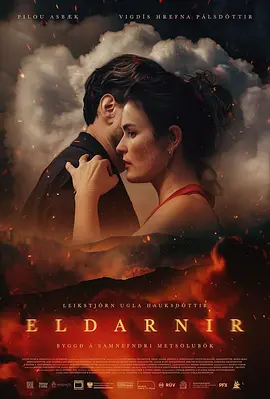
Anna Arnardóttir, Iceland's top volcanologist, faces two catastrophes at once: A volcanic eruption that threatens the safety of the capital city and a love affair that could destroy her marriage.
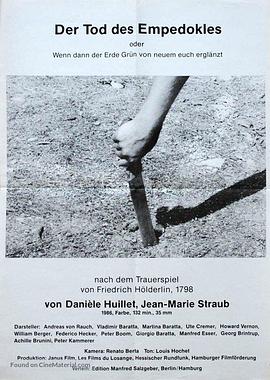
The subject of Danièle Huillet and Jean-Marie Straub’s Der Tod des Empedokles (The Death of Empedocles, 1987) is the Greek pre-Socratic philosopher Empedocles (c. 490 BC – 430 BC), who lived in the Greek colony of Agrigentum in Sicily. His theories are mentioned in several of Plato’s dialogues. He maintained that all matter is made up of four irreducible elements water, earth, air and fire. A mystic and a poet, he is considered to be the founder of classical rhetoric. He is also thought to be the last Greek philosopher to write in verse; two fragments of his works survive Katharmoi (Purifications) and Peri Phuseôs (On Nature). An advocate of democracy, he came into conflict with his fellow citizens of Agrigentum and, as result, was banished with his young disciple, Pausanius. When he was asked to return, he preferred to commit suicide by throwing himself into the active volcano at Mount Aetna. The German writer Friedrich Hölderlin wrote two versions of Der Tod des Empedokles in 1798 and 1800, and a final third version in 1820, all three ultimately unfinished. They were conceived as five-act tragedies and all three differ in plot. According to Michael Hamburger, Hölderlin’s English-language translator, the main reason why Hölderlin finished no version of the play must be that he remained too closely identified with Empedocles, at the very period in his life when his own view of the poet as philosopher, prophet and priest – and as tragic hero – was subject to perpetual crisis and re-examination. Huillet-Straub’s The Death of Empedocles is based on Hölderlin’s first version (the longest of the three), whereas Black Sin is based on the third version.
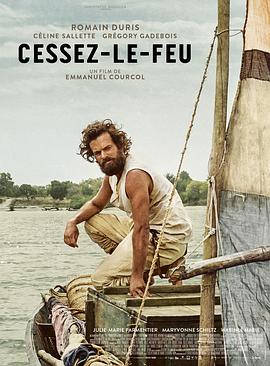
In the early 1920s, Georges Laffont (Romain Duris), traumatised by the horrific trench warfar, decides to leave his life behind and travel to West Africa into the vast territories of Upper Volta in the company of Diofo, artist and also survivor of the Great War. From village to village, Georges uses Diofo's talents as a griot to recruit the villagers as labour for plantations in Ghana. But his adventure leads him to a dead-end, and he comes back to Paris where is brother Marcel (Grégory Gadebois), a war invalid, lives with their mother's. After the war in Europe, life went out without him. Georges will desperately try to find his place, with the help of Hélène (Céline Salette), a sign language teacher with whom he will have a tumultuous relationship, and his family, that he selfishly left behind. He will finally attempt to heal their wounds, and his.